
Writing and Reading
At The Abbey, we endeavour to create a love for reading and writing.
We want every child to leave with an enthusiastic desire to read and write with the skills to do so. By teaching our children how to read and write, we hope that they will use these skills to become advocates for social justice, fighters for sustainability, seekers of equality and leaders seeking to become “builders of a new humanity” (Pope Francis).
For handwriting, we follow the Achieving Excellence in Handwriting programme by ISHA which teaches children the different letter families and how to form letters of the correct height in relation to each other. During Year 2, joins are introduced and these joins are then developed throughout Key Stage 2. For spelling, we follow the Spelling Shed long term plan, where children learn the spelling rules for their year band alongside common exception words. From Year 2, pupils are set weekly spellings and are then tested on these words.
Reading
At The Abbey we LOVE reading!
Reading is celebrated in all classrooms with our inviting reading areas and throughout the year, children democratically vote for a year band poet, author and illustrator. Each class has their own librarian, whose jobs include upkeep of the reading area, introducing new books to the classroom and celebrating themed days and weeks with their class, such as National Poetry Week.
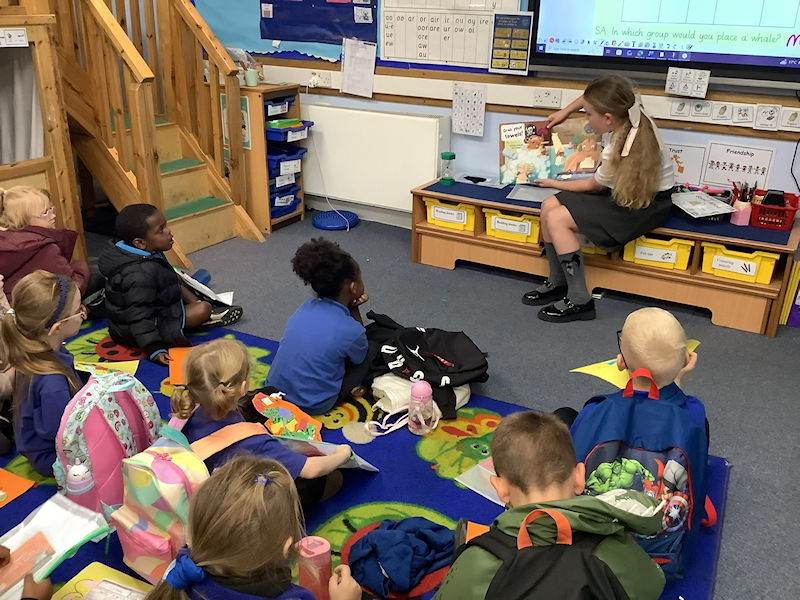
Every afternoon, the whole school is invited to stop what they are doing and enjoy a story together with their class teacher. This protected time is invaluable and for many – staff and children alike – this is their favourite time of the school day. The reading environment, engagements of the pupils and the expression of the reader are all celebrated with our weekly award – Reader of the Week – where classes receive rewards for doing this well. The winners are announced weekly by our Year 6 Reading Ambassadors during our Gifts from God assemblies.
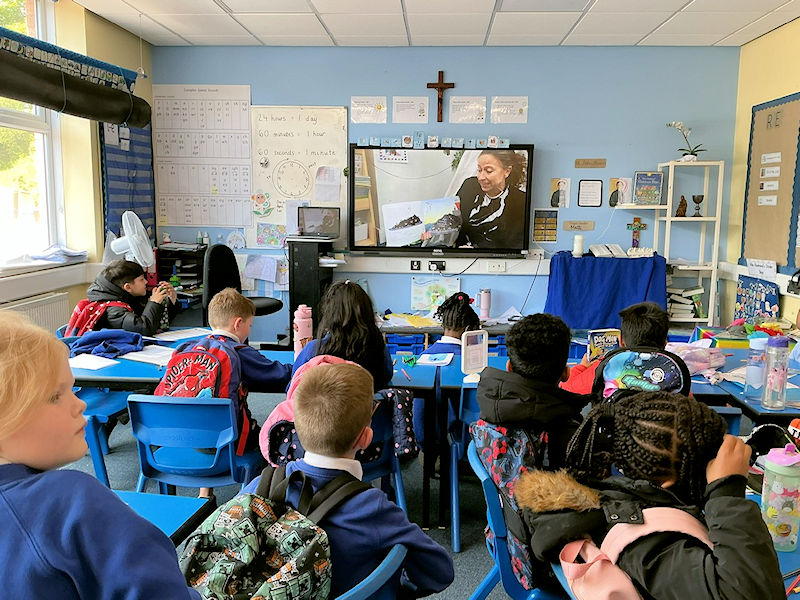
To support and encourage reading at home, a video is uploaded to our weekly newsletter of a staff member reading a story for the school community. The stories shared are then placed on a reading display for children to borrow and read for themselves. Children look forward to seeing who each week’s reader will be.
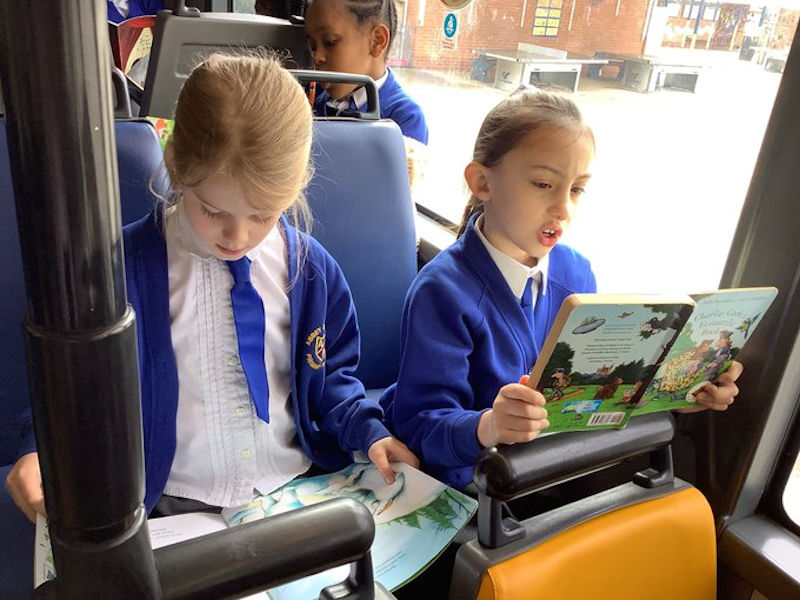
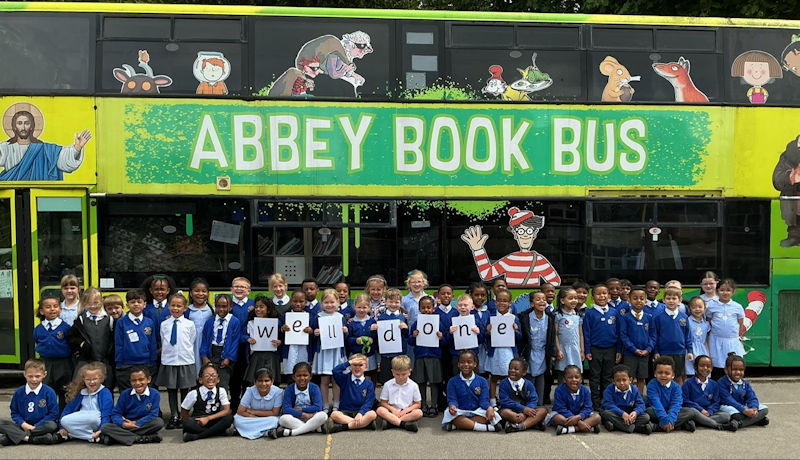
Our Book Bus offers an innovative space where pupils can access a variety of books at play and lunch times. Our Book Bus librarians encourage children to visit and enjoy the Book Bus and work together to update displays. We encourage classes to visit the Book Bus at other times during the school day to share a story in a new environment.
The introduction of our Book Vending Machine has been a huge success and pupils are keen to be awarded an Abbey Values certificate in order to ‘purchase’ a book. Pupils can often be seen, when lining up for dinner, looking at the books and discussing which one they would like to ‘buy’.
Our Reading Records are a celebration of what our children are reading at home and at school. Children can earn certificates in their Reading Records for reading for a certain number of days and we celebrate when children earn these through group photographs during Gifts from God assemblies.
Reading: Phonics
See our dedicated Phonics page for full information.
Reading: Guided Reading
When pupils have graduated from the Phonics programme, they take part in Guided Reading lessons. In these lessons, pupils are explicitly taught the reading content domains through age-appropriate texts that engage and inspire pupils. Through partner and whole class discussions, we delve deeper into the texts, looking at retrieval, inference, prediction, explanation, vocabulary, sequencing and summarising. We work on our stamina for reading through weekly or fortnightly comprehensions and explore the mark schemes together to get a better understanding of how to answer questions well.
Every term, children’s reading ability is assessed using NTS Reading comprehension tests (for Years 1 to 5) or past SATS papers for Year 6, which assess both fluency and comprehension. The results of these tests inform our teachers on which content domains need a priority focus for the next term of teaching. Pupils are then informed of their ZPD (their reading level) and this allows them to choose reading books for school and home that match their reading age.